

How much does commercial kitchen exhaust hood cleaning cost? The answer depends on the restaurant’s exhaust system, grease accumulation, accessibility, cooking volume, service frequency, and scope of work.
There is no universal price that applies to every commercial kitchen. A small restaurant with one easily accessible exhaust system may require significantly less labor than a high-volume kitchen with multiple hoods, long duct runs, or difficult rooftop access.
For restaurant owners and facility managers, understanding these variables is essential for evaluating quotes, planning maintenance budgets, and selecting qualified contractors.
At MFS Trade School, Founder and CEO Christos “Chris” Daskalakis emphasizes the importance of understanding the technical work behind commercial kitchen exhaust cleaning, including the factors that influence professional service pricing.
For restaurant owners seeking additional information about professional kitchen exhaust cleaning, the National Hood Cleaners Association (NHCA) provides educational resources and industry information. Visit the association’s About Us page to learn more about its mission and commitment to professional kitchen exhaust cleaning standards.
This guide explains what commercial kitchen exhaust hood cleaning costs include, how contractors calculate their rates, and what restaurant operators should consider before hiring a cleaning provider.
Quick Answer: How Much Does Commercial Kitchen Exhaust Hood Cleaning Cost?
Commercial kitchen exhaust hood cleaning cost varies according to system size, grease buildup, accessibility, labor requirements, cleaning frequency, and service scope.
A practical way to understand pricing is:
System Size + Grease Accumulation + Accessibility + Labor + Cleaning Frequency + Service Scope = Commercial Kitchen Exhaust Hood Cleaning Cost
This is a conceptual pricing framework, not a mathematical formula for calculating a quote.
A restaurant with a straightforward exhaust system and light grease accumulation may require less labor than a high-volume commercial kitchen with multiple exhaust fans, extensive ductwork, or heavy grease deposits.
The most useful estimate is not necessarily the cheapest. It is the one that clearly identifies the work included, the conditions affecting the price, and any additional charges.
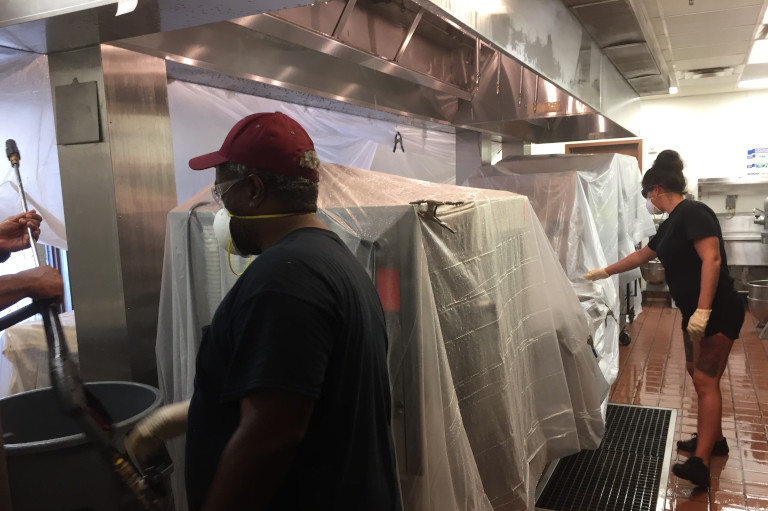
What Does Commercial Kitchen Exhaust Hood Cleaning Cost Include?
Professional commercial kitchen exhaust cleaning involves more than washing the visible stainless-steel hood.
Depending on the system configuration, accessibility, and agreed scope, professional services may include:
- Protection of cooking equipment and surrounding surfaces
- Removal and cleaning of grease filters
- Interior exhaust hood cleaning
- Hood plenum cleaning
- Accessible exhaust duct cleaning
- Exhaust fan cleaning
- Grease containment and cleanup
- Degreasers and cleaning chemicals
- Wastewater and debris management
- Final workspace cleanup
- Before-and-after photographs
- Service documentation
Restaurant owners should confirm which components are included before accepting a proposal.
A quote covering only the hood and filters is not directly comparable with a proposal addressing the hood, plenum, accessible ductwork, exhaust fan, containment, cleanup, and documentation.
The scope of work is one of the most important factors when evaluating commercial kitchen exhaust hood cleaning prices.
What Factors Affect Commercial Kitchen Exhaust Hood Cleaning Prices?
1. Exhaust Hood Size and System Layout
The size and configuration of the commercial kitchen exhaust system can significantly affect labor requirements.
Contractors may evaluate:
- Hood length
- Number of grease filters
- Number of exhaust systems
- Ductwork configuration
- Number of exhaust fans
- Access-panel locations
- Rooftop access
- System height and accessibility
Two restaurants with similar hood dimensions may require very different amounts of work.
A system with straightforward access may be cleaned more efficiently than one with extensive ductwork, limited access points, or challenging rooftop conditions.
2. Cooking Volume and Grease Accumulation
Restaurants operating fryers, grills, charbroilers, or woks may generate substantial grease-laden vapors.
Over time, grease deposits can accumulate throughout the exhaust system.
Heavier grease accumulation may require:
- Additional degreasing chemicals
- More manual scraping
- Repeated cleaning passes
- Additional exhaust fan cleaning
- Longer labor time
- More containment and cleanup
For this reason, professional kitchen hood cleaning estimates should account for the condition of the exhaust system rather than relying exclusively on hood dimensions.
3. Commercial Kitchen Exhaust Cleaning Frequency
Regular maintenance can make cleaning requirements more predictable by helping manage grease accumulation.
Long periods between cleanings may result in heavier or hardened deposits that require additional labor.
The appropriate cleaning schedule depends on cooking operations, grease accumulation, inspection findings, and applicable requirements.
Restaurants should not assume that every kitchen requires the same cleaning frequency.
4. Accessibility and Rooftop Conditions
Commercial kitchen exhaust systems often include rooftop exhaust fans and ductwork located in difficult-to-access areas.
Access conditions can affect equipment requirements, staffing, preparation time, and safety procedures.
For example, a restaurant with accessible rooftop equipment may present fewer logistical challenges than a facility requiring specialized access arrangements.
Contractors should evaluate these conditions before preparing a final estimate.
5. Labor and Geographic Location
Commercial kitchen exhaust hood cleaning rates can vary by region.
Labor expenses, transportation, local operating costs, and competition can influence pricing.
A quote in one metropolitan market may differ from a quote for a similar system in another area.
Restaurant operators should compare qualified local providers rather than assuming a single national price applies everywhere.
6. Service Scope and Documentation
Not every commercial kitchen exhaust cleaning proposal includes identical services.
Some contractors may quote a limited cleaning scope, while others include more extensive system cleaning and documentation.
Restaurant owners should confirm whether the proposal includes accessible ductwork, exhaust fans, containment, cleanup, and service reporting.
Clear documentation helps prevent misunderstandings about what work was completed.
How Are Commercial Kitchen Exhaust Hood Cleaning Rates Structured?
Commercial kitchen exhaust cleaning contractors may use different pricing methods.
Flat-Rate Pricing
A contractor provides a fixed quote based on the expected work.
This can simplify budgeting when the proposal clearly defines the service scope, assumptions, and exclusions.
Per-Hood or System-Based Pricing
Some contractors use hood dimensions or the number of exhaust systems as part of their estimating process.
However, hood size alone does not account for grease accumulation, access conditions, or job complexity.
Labor-Based Pricing
Unusual systems, substantial grease buildup, or unpredictable conditions may require pricing that considers technician hours.
Recurring Maintenance Pricing
Restaurants receiving regular service may benefit from more predictable estimates because the contractor is familiar with the system, access requirements, and typical grease accumulation.
Regardless of the pricing method, restaurant operators should compare equivalent service scopes rather than total prices alone.
What Information Should You Provide When Requesting a Commercial Hood Cleaning Quote?
Providing accurate information can help contractors prepare more reliable estimates.
Before contacting a commercial kitchen exhaust cleaning company, gather:
- Number of kitchen exhaust hood systems
- Approximate hood dimensions
- Number of grease filters
- Cooking equipment under each hood
- Restaurant operating hours
- Date of the last professional cleaning
- Exhaust fan locations
- Roof-access information
- Known access limitations
- Current grease or airflow concerns
- Recent inspection findings
- Preferred service window
Photographs of the hood, cooking line, filters, exhaust fan, and roof-access areas may also help contractors understand the system.
A professional provider may still need to inspect the site before confirming the final price.
Why the Cheapest Commercial Kitchen Hood Cleaning Quote May Not Be the Best Value
Restaurant operating margins matter, so price is an important purchasing consideration.
However, an unusually low commercial kitchen exhaust hood cleaning quote should prompt additional questions.
Consider whether the proposal includes:
Hood + Filters + Plenum + Accessible Ducts + Exhaust Fan + Containment + Cleanup + Documentation
Compare that with a proposal covering only:
Hood + Filters
These are not equivalent scopes of work.
Restaurant operators should also ask about:
- Protection of kitchen equipment
- Rooftop cleaning procedures
- Wastewater management
- Difficult access
- Before-and-after photographs
- Reporting of deficiencies
- Additional labor charges
- Insurance and contractor qualifications
The objective is to find an appropriate balance between price, scope, professionalism, and documentation.
How to Compare Commercial Kitchen Exhaust Hood Cleaning Quotes
Before selecting a contractor, create a simple comparison table.
| Service Component | Quote A | Quote B | Quote C |
|---|---|---|---|
| Hood and filters | Verify | Verify | Verify |
| Plenum | Verify | Verify | Verify |
| Accessible ductwork | Verify | Verify | Verify |
| Exhaust fan | Verify | Verify | Verify |
| Grease containment | Verify | Verify | Verify |
| Rooftop cleanup | Verify | Verify | Verify |
| Before-and-after photos | Verify | Verify | Verify |
| Service documentation | Verify | Verify | Verify |
| Insurance and qualifications | Verify | Verify | Verify |
| Total quoted cost | Enter price | Enter price | Enter price |
This comparison makes it easier to understand why one proposal may cost more than another.
The best way to compare commercial kitchen exhaust hood cleaning prices is to evaluate the complete scope of work, contractor qualifications, cleanup, and documentation rather than comparing the final price alone.
How Does NFPA 96 Relate to Commercial Kitchen Exhaust Hood Cleaning?
Commercial kitchen exhaust cleaning is connected to fire prevention because grease deposits can accumulate inside ventilation systems.
The National Fire Protection Association publishes NFPA 96, the Standard for Ventilation Control and Fire Protection of Commercial Cooking Operations.
NFPA 96 addresses commercial cooking ventilation and fire protection, including relevant inspection and cleaning requirements.
However, inspection frequency and actual cleaning frequency are not necessarily identical.
The appropriate cleaning schedule depends on grease accumulation, inspection findings, applicable local requirements, and the edition of the standard adopted by the jurisdiction.
Restaurant operators should consult qualified professionals and the local authority having jurisdiction when determining applicable requirements.
For contractors, understanding NFPA 96 is an important part of professional education.
How to Set a Realistic Restaurant Kitchen Hood Cleaning Budget
Restaurant operators should treat professional kitchen exhaust cleaning as a recurring maintenance expense.
A simple annual budgeting formula is:
Average Cost Per Cleaning × Expected Annual Cleaning Visits = Estimated Annual Cleaning Budget
For example, if a restaurant receives a quote of $600 per cleaning and expects four visits annually, its preliminary annual cleaning budget would be:
$600 × 4 = $2,400 per year
This is a hypothetical calculation, not a recommended cleaning frequency or an established market rate.
The actual number of required visits should be based on system conditions and applicable requirements.
Additional work, difficult access, or unexpected grease accumulation may affect the final annual expense.
Planning ahead can help restaurant operators manage maintenance costs more effectively.
Chris Daskalakis on Professional Kitchen Exhaust Cleaning and Business Education
Christos “Chris” Daskalakis is the Founder and CEO of MFS Trade School, a specialized training and certification provider based in Sanford, Florida.
His professional background includes construction contracting, commercial kitchen exhaust cleaning, fire safety, and entrepreneurship.
Before establishing MFS Trade School, Chris developed practical experience in commercial kitchen exhaust cleaning and related services.
He also pursued additional fire-safety education and worked as a private fire inspector.
That experience helped shape his understanding of professional service standards, technical training, and business operations.
Through MFS Trade School, Chris helps aspiring technicians, contractors, and entrepreneurs develop knowledge relevant to the commercial kitchen cleaning industry.
His educational approach emphasizes the importance of understanding both the technical service and the business responsibilities behind it.
For aspiring contractors, commercial kitchen exhaust cleaning pricing is not simply about choosing a number.
It requires understanding labor, equipment, chemicals, transportation, overhead, system complexity, and professional expectations.
MFS Trade School provides technical training and business education through its relevant programs.
Explore MFS Trade School’s Kitchen Exhaust Hood Cleaning Certification Program
Frequently Asked Questions About Commercial Kitchen Exhaust Hood Cleaning Cost
How much does commercial kitchen exhaust hood cleaning cost?
Commercial kitchen exhaust hood cleaning cost depends on system size, grease accumulation, accessibility, cooking volume, labor requirements, service frequency, and cleaning scope. A professional estimate should identify the work included.
What is normally included in commercial kitchen exhaust hood cleaning?
Depending on system configuration and agreed scope, service may include the hood, grease filters, plenum, accessible ducts, exhaust fan, containment, cleanup, and documentation.
Why do commercial kitchen hood cleaning quotes vary?
Quotes can differ because of system complexity, grease accumulation, accessibility, labor costs, geographic location, and differences in the proposed scope of work.
Does regular commercial kitchen exhaust cleaning cost less?
Regular maintenance may make service requirements more predictable and reduce the likelihood of excessive grease accumulation. Actual pricing depends on the system and provider.
Should restaurant owners choose the cheapest hood cleaning company?
Not automatically. Restaurant owners should compare service scope, contractor qualifications, insurance, documentation, kitchen protection, and total cost.
Does NFPA 96 determine commercial kitchen hood cleaning prices?
No. NFPA 96 addresses commercial cooking ventilation and fire protection requirements. It does not establish a universal price for professional kitchen exhaust cleaning.
How often should commercial kitchen exhaust systems be cleaned?
Cleaning needs depend on grease accumulation, inspection findings, cooking operations, and applicable local requirements. Inspection intervals should not automatically be treated as cleaning intervals.
Can I learn how to start a commercial kitchen exhaust cleaning business?
Yes. MFS Trade School provides specialized kitchen exhaust hood cleaning training and certification, with business education available through relevant programs for aspiring entrepreneurs and existing service-business owners.
Final Thoughts: Understanding Commercial Kitchen Exhaust Hood Cleaning Cost
Understanding commercial kitchen exhaust hood cleaning cost begins with understanding what the contractor is being asked to clean.
Rather than asking only:
“How much does hood cleaning cost?”
Restaurant operators should also ask:
“What exactly is included in the price, and is the contractor qualified to perform the work?”
Comparing equivalent scopes, understanding system conditions, and maintaining accurate documentation can help restaurant owners make more informed purchasing decisions.
For aspiring entrepreneurs, these same principles demonstrate why technical training, estimating, and business education are important in the commercial kitchen exhaust cleaning industry.
MFS Trade School helps individuals develop specialized knowledge and explore business opportunities through professional training and certification programs.
Explore MFS Trade School’s Kitchen Exhaust Hood Cleaning Certification Program
Learn the trade. Understand professional standards. Build your business knowledge.