
A professional hood cleaning service checklist helps restaurant owners understand what to review after commercial kitchen exhaust cleaning.
Cleaning a restaurant hood involves more than removing grease from visible stainless-steel surfaces. Grease can accumulate inside filters, plenums, ductwork, and exhaust fans.
While restaurant managers should not attempt to inspect hazardous or inaccessible exhaust components themselves, they can review service documentation, ask questions, and confirm that the contractor completed the agreed work.
Use these seven checks to evaluate a completed cleaning appointment.
Quick Answer: How Do You Verify Professional Hood Cleaning?
To review a completed hood cleaning service, confirm that the contractor addressed the agreed exhaust-system components, protected the kitchen, cleaned the work area, provided accurate documentation, and reported inaccessible areas or deficiencies.
A restaurant hood cleaning checklist should cover:
- Cleaning scope
- Hood and filter condition
- Ductwork and exhaust fan documentation
- Kitchen protection and cleanup
- Service reports and photographs
- Deficiency reporting
- Follow-up maintenance planning
A clean-looking hood alone does not verify that the entire exhaust system was serviced.
1. Confirm the Agreed Cleaning Scope
Start by reviewing the contractor’s written scope of work.
Depending on the system, professional cleaning may address:
- Hood interiors
- Grease filters
- Plenum chambers
- Accessible ductwork
- Exhaust fan components
- Grease collection areas
Compare the original agreement with the completed service report.
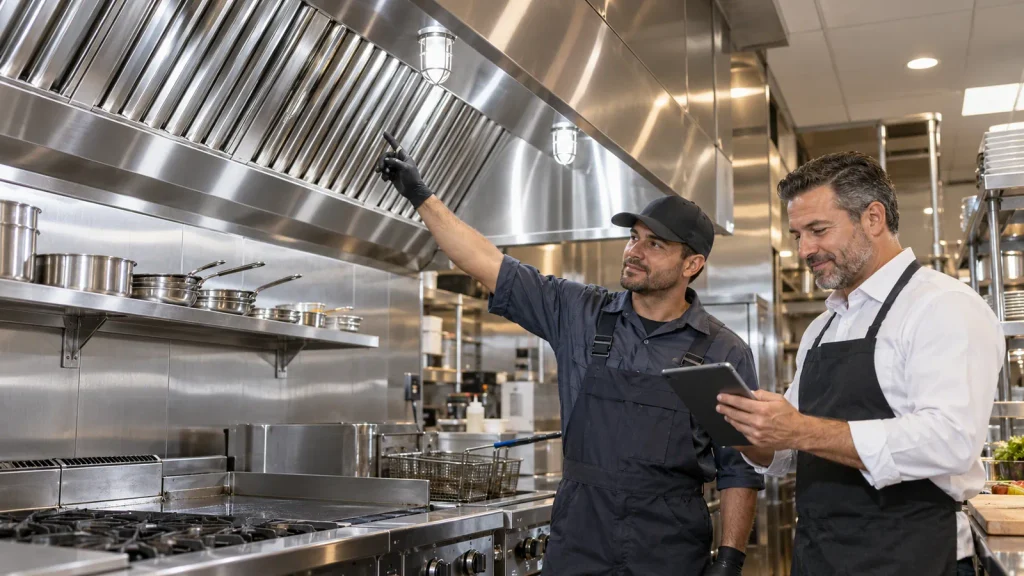
Ask the contractor to identify which components were cleaned and whether any areas required additional attention.
2. Review Hood and Filter Condition
Restaurant managers can visually review safely accessible areas after the contractor finishes.
Check whether:
- Visible hood surfaces appear free of significant grease deposits.
- Removable filters have been reinstalled appropriately.
- Grease and cleaning residue have been removed from the immediate work area.
- The contractor has reported damaged or missing components.
Avoid removing equipment or accessing concealed areas without appropriate training and authorization.
Visible cleanliness is useful, but it is only one part of evaluating professional service.
3. Verify Ductwork and Exhaust Fan Documentation
Grease accumulation often occurs in areas restaurant employees cannot easily see.
These may include:
- Horizontal ducts
- Vertical ducts
- Plenum areas
- Exhaust fan housings
- Rooftop grease collection components
Ask the contractor for photographs or other documentation showing the condition of serviced areas.
If access limitations prevented cleaning, the report should identify those limitations.
Do not assume inaccessible components were cleaned simply because the visible hood looks clean.
4. Check Kitchen Protection and Cleanup
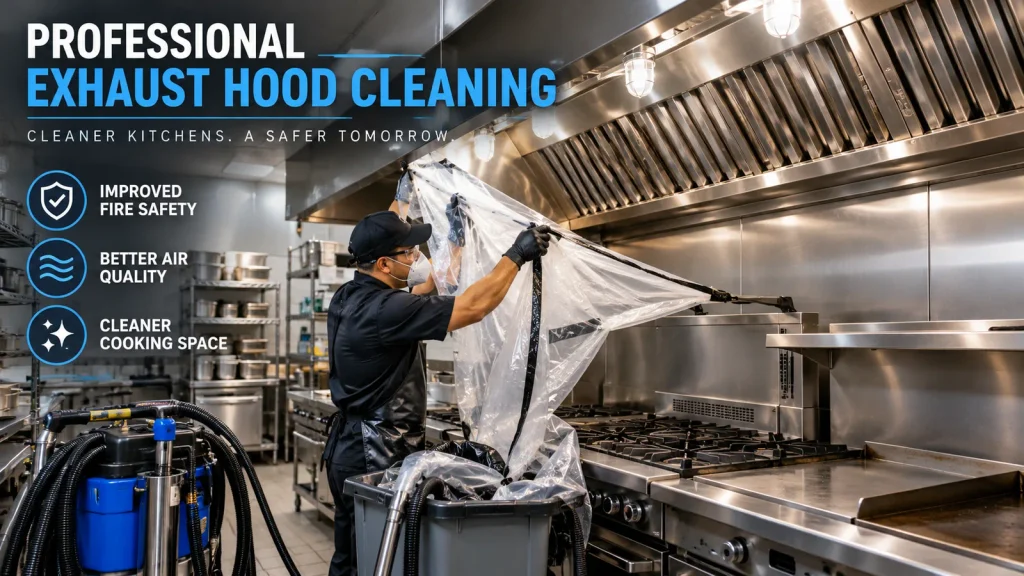
Professional exhaust cleaning requires appropriate protection of cooking equipment and surrounding surfaces.
After service, confirm that:
- Temporary containment materials have been removed.
- Cleaning equipment and hoses are cleared.
- Wastewater and cleaning residues have been managed appropriately.
- The immediate work area has been cleaned.
- Removed components have been reinstalled as appropriate.
- Any remaining concerns have been communicated.
If the kitchen is not ready for normal operations, contact the contractor before restarting affected equipment.
5. Review the Hood Cleaning Service Report
A professional service report helps document completed maintenance.
Ask whether the report includes:
- Date of service
- Contractor information
- Exhaust-system components cleaned
- Before-and-after photographs
- Cleaning label information
- Inaccessible areas
- Visible deficiencies
- Recommended corrective actions
Service records can support maintenance planning and provide information during inspections.
A cleaning label should not replace an accurate record of the work performed.
6. Identify Outstanding Deficiencies
Some problems cannot be resolved through cleaning alone.
Examples may include:
- Inaccessible duct sections
- Damaged grease filters
- Missing access panels
- Exhaust fan maintenance concerns
- Grease leakage
- Other observed system deficiencies
A professional contractor should communicate identified concerns and explain whether additional work or specialist evaluation may be necessary.
Restaurant owners should not assume that completing a cleaning appointment resolves every ventilation or fire-safety issue.
7. Plan the Next Inspection and Maintenance Review
After reviewing the completed service, update your restaurant’s maintenance records.
Cleaning frequency depends on factors such as:
- Cooking volume
- Fuel type
- Grease production
- Operating hours
- System condition
- Inspection findings
- Applicable local requirements
NFPA 96 addresses commercial cooking ventilation inspection, maintenance, and cleaning.
Inspection intervals and cleaning intervals are not necessarily identical.
A contractor can help explain observed conditions, while the applicable Authority Having Jurisdiction (AHJ) determines how local requirements apply.
Printable Restaurant Hood Cleaning Checklist
Use this checklist after a professional cleaning appointment.
| Quality Check | What to Verify |
|---|---|
| Cleaning scope | Agreed components were addressed |
| Hood and filters | Visible areas cleaned and components appropriately reinstalled |
| Ductwork | Cleaning documented; access limitations identified |
| Exhaust fan | Serviced areas documented |
| Kitchen protection | Containment removed and work area cleaned |
| Service report | Accurate record received |
| Photographs | Available evidence reviewed |
| Deficiencies | Outstanding concerns documented |
| Follow-up | Next inspection and maintenance needs recorded |
This checklist supports management review. It is not a substitute for a qualified inspection or verification required by local authorities.
What If the Hood Cleaning Service Was Incomplete?
If documentation or visible conditions raise concerns:
- Review the original service agreement.
- Identify the components or tasks in question.
- Request clarification from the contractor.
- Ask for supporting photographs or records.
- Document any unresolved concerns.
- Arrange corrective work or qualified inspection when appropriate.
Address significant fire-safety concerns promptly rather than waiting for the next scheduled cleaning.
About Chris Daskalakis
Chris Daskalakis is the founder of MFS Trade School and an entrepreneur focused on helping individuals build businesses in the commercial kitchen exhaust cleaning industry. Through MFS Trade School, Chris helps aspiring entrepreneurs and existing service-business owners develop the technical knowledge and business fundamentals needed to enter the kitchen exhaust hood cleaning industry.
Frequently Asked Questions
What should I check after professional hood cleaning?
Review the cleaning scope, visible hood condition, service report, photographs, inaccessible-area notes, deficiencies, and cleanup.
Should a hood cleaning company provide before-and-after photographs?
Photographs are highly recommended because they help document work performed in areas restaurant managers cannot easily inspect.
Does a clean hood mean the exhaust system is clean?
Not necessarily. Grease may remain inside plenums, ducts, or exhaust fans even when visible surfaces appear clean.
What should a hood cleaning service report include?
A useful report identifies the service date, components cleaned, inaccessible areas, deficiencies, and recommended corrective actions.
How often should restaurant exhaust systems be cleaned?
Cleaning frequency depends on grease accumulation, cooking operations, inspection findings, and applicable local requirements.
Final Thoughts
A hood cleaning service checklist helps restaurant owners evaluate completed work and maintain better service records.
The most important checks involve cleaning scope, documentation, kitchen cleanup, inaccessible areas, and follow-up maintenance.
A professional contractor should help restaurant management understand what was completed and what still requires attention.
Explore Professional Hood Cleaning Resources Through NHCA
The National Hood Cleaners Association (NHCA) provides resources for restaurant owners, facility managers, and commercial kitchen professionals.
Visit NHCA to explore commercial kitchen exhaust cleaning resources and learn more about professional maintenance practices.
Interested in Professional Hood Cleaning Training?
MFS Trade School provides Kitchen Exhaust Hood Cleaning Certification for entrepreneurs, pressure washing companies, commercial cleaners, and existing service-business owners.
Training covers exhaust systems, professional cleaning procedures, equipment, safety, documentation, estimating, pricing, and business development.
Explore MFS Trade School’s Kitchen Exhaust Hood Cleaning Certification and develop the skills needed to enter the commercial kitchen exhaust cleaning industry.