

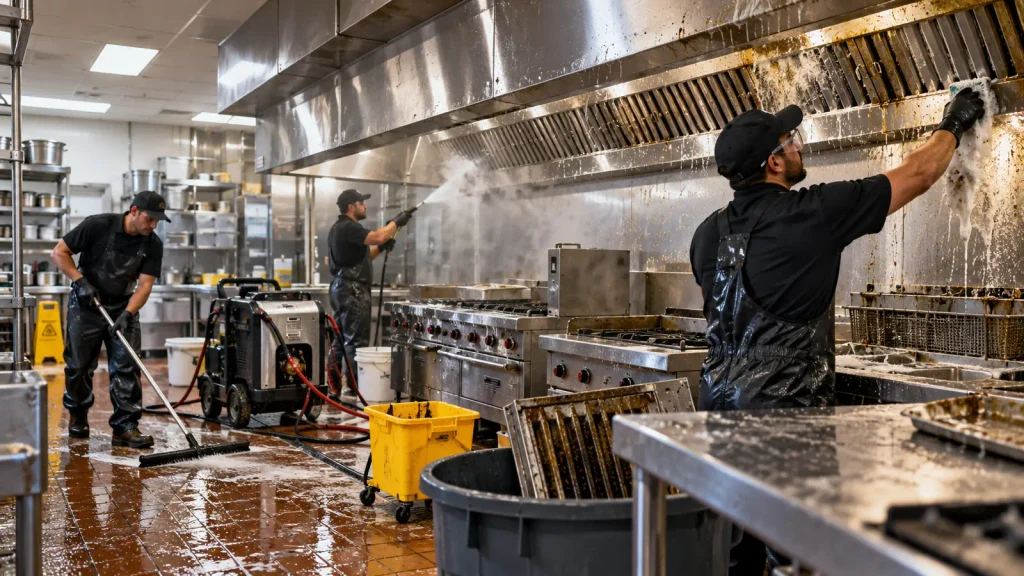
Understanding commercial hood cleaning cost helps restaurant owners plan maintenance budgets, compare estimates, and avoid unexpected expenses.
Professional kitchen exhaust cleaning involves removing grease from hoods, plenums, ductwork, and exhaust fans. Pricing depends on system size, grease accumulation, accessibility, and service requirements.
Quick Answer: How Much Does Commercial Hood Cleaning Cost?
Commercial hood cleaning prices vary based on exhaust-system size, grease buildup, ductwork complexity, rooftop access, labor, and cleaning frequency.
There is no universal rate for every restaurant. The most accurate approach is requesting an itemized estimate based on your kitchen’s actual conditions.
Here are seven factors that influence pricing.
1. Hood Size and Number of Systems
Larger exhaust systems generally require more cleaning time and materials.
Contractors evaluate:
- Hood length
- Number of filters
- Number of exhaust systems
- Plenum configuration
- Exhaust fan quantity
Two restaurants with similar kitchen sizes may have different cleaning costs because their ventilation systems differ.
2. Ductwork Complexity
Duct configuration affects labor requirements.
Long vertical ducts, multiple bends, restricted access panels, and multi-story buildings can make cleaning more complicated.
Contractors should evaluate accessibility before providing a final estimate.
Inaccessible areas must be documented rather than reported as cleaned.
3. Rooftop Exhaust Fan Access
Commercial exhaust fans are frequently located on rooftops.
Cleaning may require additional equipment, safety precautions, and preparation.
Pricing depends on roof accessibility, fan configuration, grease accumulation, and working conditions.
Damaged components or restricted access may require separate corrective work.
4. Cooking Volume and Grease Accumulation
Restaurants using fryers, charbroilers, griddles, or woks may accumulate substantial grease deposits.
Heavy buildup can require:
- Additional scraping
- More degreaser
- Repeated cleaning passes
- Longer labor time
- Additional containment and cleanup
Contractors should consider the system’s condition rather than calculate prices using hood dimensions alone.
5. Labor and Scheduling
Restaurant hood cleaning often happens overnight or during scheduled downtime.
Pricing may vary depending on:
- Number of technicians
- Service duration
- After-hours requirements
- Travel distance
- Local labor rates
- Limited access windows
Ask whether the estimate includes scheduling and travel charges.
6. Cleaning Scope and Documentation
Not every hood cleaning quote includes identical services.
Depending on system design and accessibility, professional cleaning may address:
- Hood interiors and filters
- Plenum chambers
- Accessible ductwork
- Exhaust fan components
- Grease collection areas
- Kitchen containment
- Wastewater management
- Final cleanup
- Service documentation
Before-and-after photographs and deficiency reports help restaurant owners understand the completed work.
Always compare the complete cleaning scope, not just the final price.
7. Cleaning Frequency and Maintenance History
Regular maintenance may help prevent excessive grease accumulation and make future service more predictable.
However, inspection frequency and cleaning frequency are not necessarily identical.
NFPA 96 addresses commercial cooking ventilation inspection, maintenance, and cleaning.
Actual cleaning needs depend on grease accumulation, inspection findings, and applicable local requirements.
Restaurants should confirm requirements with their local Authority Having Jurisdiction (AHJ).
How Are Commercial Hood Cleaning Services Priced?
Contractors may use different pricing structures.
| Pricing Method | Description |
|---|---|
| Flat-rate | Fixed price for an agreed scope |
| Per-system | Based on exhaust-system configuration |
| Labor-based | Based partly on technician time |
| Recurring service | Agreed pricing for scheduled visits |
The pricing model matters less than understanding what the service includes.
Commercial Hood Cleaning vs. General Kitchen Cleaning
These services are different.
| Service | Primary Purpose |
|---|---|
| Daily kitchen cleaning | Routine hygiene and surface maintenance |
| Deep kitchen cleaning | Cleaning floors, walls, and equipment exteriors |
| Kitchen exhaust cleaning | Removing grease from ventilation systems |
| Grease filter cleaning | Maintaining removable filters |
General cleaning companies may not have the equipment or qualifications required for specialized exhaust cleaning.
What Should a Hood Cleaning Quote Include?
Before approving an estimate, confirm:
- Exhaust components included
- Known access limitations
- Kitchen protection procedures
- Cleanup responsibilities
- Service documentation
- Potential additional charges
- Estimated completion time
- Service exclusions
A detailed written quote helps prevent misunderstandings.
How to Calculate Your Annual Hood Cleaning Budget
Use this formula:
Cost Per Cleaning × Annual Cleaning Visits = Estimated Annual Budget
For example:
| Budget Item | Hypothetical Example |
|---|---|
| Cost per visit | $600 |
| Annual visits | 4 |
| Annual budget | $2,400 |
These figures illustrate the calculation; they are not verified market averages or a recommended cleaning schedule.
Use actual contractor estimates and applicable maintenance requirements.
5 Ways to Manage Hood Cleaning Expenses
Restaurant owners can improve maintenance planning by:
- Maintaining appropriate filter care.
- Keeping access points accessible.
- Retaining cleaning and inspection records.
- Addressing reported deficiencies promptly.
- Scheduling professional service according to system conditions and applicable requirements.
These practices support maintenance but do not replace professional exhaust cleaning.
About Chris Daskalakis
Chris Daskalakis is the founder of MFS Trade School and an entrepreneur focused on helping individuals build businesses in the commercial kitchen exhaust cleaning industry. Through MFS Trade School, Chris helps aspiring entrepreneurs and existing service-business owners develop the technical knowledge and business fundamentals needed to enter the kitchen exhaust hood cleaning industry.
Frequently Asked Questions
How much does commercial hood cleaning cost?
Pricing depends on system size, grease accumulation, accessibility, labor, scheduling, and cleaning scope. Request an itemized estimate for accurate pricing.
Why do restaurant hood cleaning prices vary?
Restaurants have different ventilation configurations, cooking volumes, maintenance histories, and accessibility requirements.
Does rooftop exhaust fan cleaning cost extra?
It depends on the contractor’s scope and access conditions. Confirm whether fan cleaning is included.
Can regular maintenance reduce costs?
Regular maintenance may make service needs more predictable, but lower prices are not guaranteed.
Is kitchen deep cleaning the same as hood cleaning?
No. Deep cleaning focuses on kitchen surfaces, while professional exhaust cleaning addresses grease inside ventilation systems.
Final Thoughts
Understanding commercial hood cleaning cost requires evaluating your restaurant’s exhaust system, grease accumulation, accessibility, and maintenance needs.
Request detailed estimates and compare the actual services included before selecting a provider.
Explore Commercial Kitchen Exhaust Cleaning Resources
The National Hood Cleaners Association (NHCA) provides industry resources for restaurant owners, facility managers, and commercial kitchen professionals.
Visit NHCA to learn more about professional exhaust cleaning and commercial kitchen maintenance.
Interested in Starting a Commercial Hood Cleaning Business?
MFS Trade School provides Kitchen Exhaust Hood Cleaning Certification for aspiring entrepreneurs, pressure washing companies, commercial cleaners, and existing service-business owners.
Training covers exhaust systems, cleaning procedures, equipment, safety, documentation, estimating, pricing, and business development.
Explore MFS Trade School’s Kitchen Exhaust Hood Cleaning Certification to learn more about entering the industry.