
Commercial kitchen exhaust hood cleaning is an essential part of restaurant maintenance. Grease, smoke, heat, and cooking vapors travel through the exhaust system daily, creating buildup that can affect fire safety, ventilation, and equipment performance.
This guide explains what professional cleaning includes, how often restaurants should schedule service, and how to maintain a safer, more organized kitchen.
Quick Answer: What Is Commercial Kitchen Exhaust Hood Cleaning?
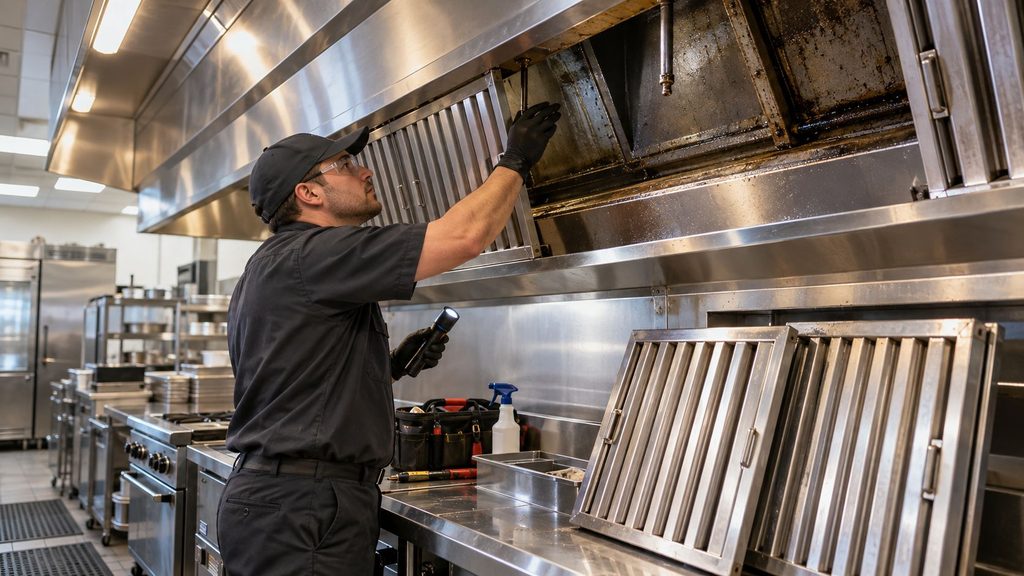
Commercial kitchen exhaust hood cleaning removes accumulated grease from accessible portions of a restaurant’s exhaust system, including the hood, filters, plenum, ductwork, and exhaust fan.
Professional cleaning helps reduce grease-related fire hazards, supports inspection readiness, and maintains cleaner exhaust pathways.
The goal is to clean the accessible exhaust system—not simply polish the visible stainless-steel hood.
1. Understand Why Restaurant Hood Cleaning Matters
Commercial cooking produces grease-laden vapors that travel through the exhaust system.
Over time, grease can accumulate inside filters, ducts, plenums, and exhaust fans.
Excessive buildup can contribute to:
- Increased fire hazards
- Restricted airflow
- Persistent cooking odors
- Difficult maintenance
- Inspection concerns
- Additional cleaning costs
Regular restaurant hood cleaning helps manage these risks while supporting safer kitchen operations.
2. Know What Professional Hood Cleaning Includes
Professional commercial kitchen exhaust hood cleaning involves more than wiping visible surfaces.
Depending on system design and accessibility, service may include:
- Hood cleaning: Removing grease from accessible interior surfaces.
- Filter cleaning: Degreasing removable grease filters.
- Plenum cleaning: Removing grease behind the filters.
- Duct cleaning: Cleaning accessible horizontal and vertical ductwork.
- Exhaust fan cleaning: Addressing grease on fan blades, housings, and related components.
- Containment and cleanup: Protecting equipment and managing wastewater.
- Documentation: Providing cleaning records, photographs, and deficiency reports.
Ask your contractor to explain exactly what is included before scheduling service.
3. Recognize Warning Signs of Grease Buildup
Even restaurants with regular maintenance schedules should monitor their exhaust systems.
Common warning signs include:
- Visible grease accumulation or dripping.
- Smoke lingering around cooking equipment.
- Persistent cooking odors.
- Unusual exhaust fan noise.
- Grease accumulation around rooftop equipment.
- Missing or outdated cleaning records.
These symptoms may indicate that cleaning, inspection, or mechanical maintenance is needed.
Do not wait for visible grease dripping or serious ventilation problems before reviewing your maintenance schedule.
4. Follow an Appropriate Hood Cleaning Schedule
Cleaning frequency depends on cooking volume, fuel type, grease production, inspection findings, and local requirements.
A commonly referenced NFPA 96 inspection framework includes:
| Cooking Operation | Typical Inspection Frequency |
|---|---|
| Solid-fuel cooking | Monthly |
| High-volume cooking | Quarterly |
| Moderate-volume cooking | Semiannually |
| Low-volume cooking | Annually |
Important: These are inspection frequencies, not automatic cleaning intervals. Actual cleaning should reflect grease accumulation and applicable requirements.
NFPA 96 is a commercial cooking fire-safety standard, not a hood cleaning certification.
Restaurants should confirm applicable requirements with their local Authority Having Jurisdiction (AHJ).
5. Separate Daily Staff Cleaning From Professional Service
Daily cleaning and professional exhaust-system cleaning serve different purposes.
Restaurant employees can maintain accessible surfaces and removable filters when appropriately trained.
Professional technicians address areas that typically require specialized equipment, access, containment, and cleaning procedures.
These may include:
- Plenum chambers
- Accessible grease ducts
- Exhaust fan components
- Rooftop grease collection areas
- Difficult-to-reach exhaust sections
A clean-looking hood exterior does not necessarily mean the entire exhaust system is clean.
6. Create a Restaurant Hood Maintenance Checklist
A documented maintenance routine helps restaurant managers stay organized.
Use this checklist:
- Confirm the next professional cleaning date.
- Maintain service reports and inspection records.
- Train employees on appropriate filter maintenance.
- Monitor grease drips, odors, and airflow concerns.
- Check for unusual exhaust fan noise.
- Report changes in cooking volume or equipment.
- Keep access points available for technicians.
- Review cleaning reports and identified deficiencies.
Inspect → Clean → Document → Address Deficiencies → Schedule Next Service
This process supports more consistent maintenance and reduces reliance on emergency cleaning.
7. Choose a Qualified Hood Cleaning Provider
Not every cleaning company specializes in commercial kitchen exhaust systems.
Before hiring a provider, ask:
- Do you clean the complete accessible exhaust system?
- Are your technicians trained and qualified?
- Are you appropriately insured?
- Do you understand applicable NFPA 96 requirements?
- Do you provide before-and-after photographs?
- Will you document inaccessible areas?
- Can you work around restaurant operating hours?
- Do you provide written service reports?
Compare providers based on scope, training, documentation, scheduling, and price, rather than choosing the lowest quote automatically.
About Chris Daskalakis
Chris Daskalakis is the founder of MFS Trade School and an entrepreneur focused on helping individuals build businesses in the commercial kitchen exhaust cleaning industry. Through MFS Trade School, Chris helps aspiring entrepreneurs and existing service-business owners develop the technical knowledge and business fundamentals needed to enter the kitchen exhaust hood cleaning industry.
Frequently Asked Questions
What is commercial kitchen exhaust hood cleaning?
It is the professional removal of accumulated grease from accessible portions of a commercial kitchen exhaust system, including hoods, filters, plenums, ducts, and exhaust fans.
How often should restaurant exhaust hoods be cleaned?
Frequency depends on cooking volume, grease accumulation, inspection results, fuel type, and local requirements.
Can restaurant employees clean the entire exhaust system?
Generally, no. Employees can maintain accessible surfaces and filters, but full-system cleaning typically requires specialized equipment and trained professionals.
Does professional hood cleaning support NFPA 96 compliance?
Yes