
Restaurant Hood Cleaning Service Near Me: 7 Essential Tips to Find the Best
Looking for a reliable restaurant hood cleaning service near me?
Choosing the right contractor is essential for maintaining a commercial kitchen exhaust system, managing grease accumulation, and supporting restaurant fire safety.
Not every cleaning company provides complete commercial kitchen exhaust cleaning. Some focus on visible hood surfaces, while professional exhaust cleaning addresses grease accumulation throughout accessible system components.
This guide explains seven essential tips for evaluating restaurant hood cleaning contractors, comparing quotes, understanding NFPA 96 requirements, and choosing a qualified service provider.
Quick Answer: How Do I Find a Restaurant Hood Cleaning Service Near Me?
To find a reliable restaurant hood cleaning service near me, look for a company specializing in commercial kitchen exhaust systems rather than general restaurant cleaning.
Before hiring, verify the contractor’s:
- Professional training and qualifications
- Commercial insurance
- Experience with kitchen exhaust systems
- Knowledge of applicable NFPA 96 requirements
- Cleaning scope and procedures
- Service documentation
- Customer references
The best restaurant hood cleaning service is one that clearly explains its qualifications, the work included, and how completed cleaning will be documented.
Use the following seven tips to evaluate potential providers.
1. Choose a Commercial Kitchen Exhaust Cleaning Specialist
Commercial kitchen exhaust cleaning is different from general restaurant cleaning.
Cooking equipment produces grease-laden vapors that travel through the exhaust ventilation system.
Over time, grease can accumulate in several components, including:
- Hood interiors
- Grease filters
- Hood plenums
- Horizontal and vertical ductwork
- Exhaust fans
- Grease collection areas
A qualified contractor should understand how these components work together and how to clean accessible grease-contaminated areas using appropriate professional procedures.
When comparing companies, ask whether they specialize in complete kitchen exhaust system cleaning or primarily offer surface cleaning.
2. Verify Training, Qualifications, and Insurance
Before hiring a restaurant hood cleaning company, confirm that its technicians have appropriate training and that the business carries suitable insurance.
Important questions include:
- Do you specialize in commercial kitchen exhaust cleaning?
- What professional training have your technicians completed?
- Do you carry appropriate commercial insurance?
- Are your technicians familiar with NFPA 96?
- Do you meet applicable local requirements?
- Can you provide commercial customer references?
Professional certification may demonstrate completed training, but it does not automatically replace local licensing, insurance, or other applicable requirements.
Restaurant owners should verify qualifications rather than relying solely on advertising claims.
3. Request a Detailed Restaurant Hood Cleaning Service Scope
A professional contractor should explain exactly what the cleaning service includes.
Depending on system design and accessibility, the scope may cover:
- Hood interior cleaning
- Grease filter cleaning
- Plenum cleaning
- Accessible ductwork
- Exhaust fan components
- Grease collection areas
- Kitchen equipment protection
- Grease containment
- Final cleanup
- Service documentation
A low-priced proposal covering only visible hood surfaces should not be confused with a proposal for comprehensive exhaust-system cleaning.
Ask contractors to identify exclusions, access limitations, and potential additional charges before work begins.
A clear written scope helps restaurant owners compare equivalent services and understand what they are purchasing.
4. Ask About NFPA 96 Requirements
NFPA 96 is the Standard for Ventilation Control and Fire Protection of Commercial Cooking Operations, published by the National Fire Protection Association.
It addresses commercial cooking ventilation systems, including relevant inspection, maintenance, and cleaning requirements.
NFPA 96 is a fire-safety standard, not an individual cleaning certification.
A knowledgeable contractor should understand the requirements relevant to the system being serviced.
Local authorities determine which editions and requirements apply.
How Often Should Restaurant Hoods Be Inspected?
A commonly referenced NFPA 96 inspection framework includes:
| Cooking Operation | Typical Inspection Interval |
|---|---|
| Solid-fuel cooking | Monthly |
| High-volume cooking | Quarterly |
| Moderate-volume cooking | Semiannually |
| Low-volume cooking | Annually |
These are commonly referenced inspection intervals, not universal cleaning schedules. Specific categories and requirements depend on the applicable edition and local jurisdiction.
Actual cleaning needs depend on grease accumulation, inspection findings, system conditions, and applicable requirements.
Restaurant owners should confirm the schedule appropriate for their facility.
5. Confirm Professional Cleaning Documentation
When searching for a restaurant hood cleaning service near me, documentation should be an important selection criterion.
Professional cleaning should include accurate records identifying the work completed.
Ask whether the contractor provides:
- Service report
- Cleaning date
- Components serviced
- Cleaning label or service sticker
- Before-and-after photographs
- Deficiency notes
- Documentation of inaccessible areas
Reports should accurately describe completed work.
If parts of the exhaust system cannot be accessed or cleaned, those limitations should be documented and communicated.
Accurate documentation helps restaurant operators maintain organized maintenance records and understand whether additional attention is necessary.
6. Compare Restaurant Hood Cleaning Quotes Beyond Price
Restaurant hood cleaning costs vary based on system complexity and service requirements.
Factors that may influence pricing include:
- Number and size of exhaust hoods
- Grease accumulation
- Ductwork configuration
- Exhaust fan accessibility
- Rooftop access
- Service frequency
- Restaurant location
- After-hours scheduling
Before choosing a contractor, compare the components included, qualifications, documentation, and cleaning procedures.
The cheapest estimate may not provide the most appropriate scope.
What Should You Compare in a Hood Cleaning Quote?
| Evaluation Factor | What to Verify |
|---|---|
| Hood and filters | Included in the scope |
| Plenum | Cleaning included |
| Accessible ductwork | Cleaning included |
| Exhaust fan | Cleaning included |
| Kitchen protection | Containment procedures |
| Rooftop work | Access and cleanup |
| Documentation | Report and photographs |
| Qualifications | Training and insurance |
| Total cost | Included services and additional charges |
A complete comparison helps restaurant owners understand why one contractor may charge more than another.
For additional information, read our guide to commercial kitchen exhaust hood cleaning costs.
7. Watch for Warning Signs When Hiring a Hood Cleaning Contractor
Not every provider offers the same level of service.
Be cautious when a company:
- Offers only visible hood cleaning without clearly identifying the limited scope
- Refuses to explain its cleaning procedures
- Does not address ductwork or exhaust fans
- Cannot explain technician qualifications
- Does not provide documentation
- Ignores inaccessible areas
- Promises identical cleaning schedules for every restaurant
- Cannot clarify applicable insurance or professional requirements
Professional service should be transparent.
Restaurant owners should know what was cleaned, what could not be accessed, and what may require further attention.
Signs Your Restaurant May Need Professional Hood Cleaning
Common warning signs include:
- Visible grease accumulation
- Grease dripping from hood components
- Persistent greasy odors
- Heavy grease buildup around exhaust fans
- Missing or outdated service records
- Inspection findings identifying grease accumulation
Smoke capture problems or reduced airflow may also indicate ventilation issues requiring professional inspection.
Do not assume cleaning alone will resolve mechanical or airflow problems.
When in doubt, consult a qualified professional familiar with commercial kitchen ventilation systems.
What Happens During a Professional Restaurant Hood Cleaning Visit?
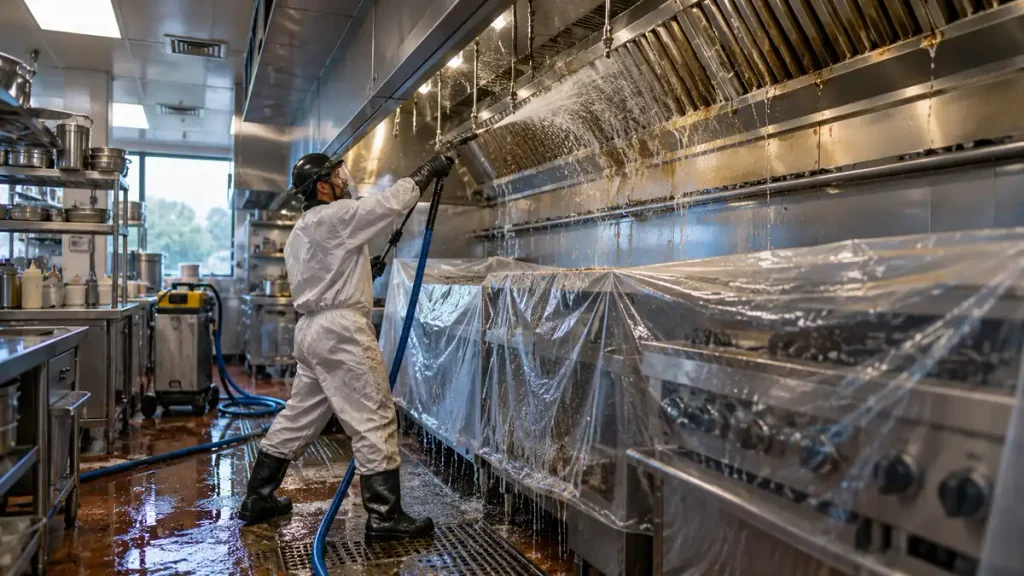
A typical commercial kitchen exhaust cleaning service may involve several stages.
1. Initial assessment: The contractor reviews the exhaust system, identifies access points, and confirms the cleaning scope.
2. Kitchen protection: Cooking equipment and surrounding surfaces are protected as appropriate.
3. Grease removal: Technicians use suitable professional procedures to remove grease from accessible system components.
4. Exhaust system cleaning: Work proceeds according to the system configuration and agreed scope.
5. Containment and cleanup: Wastewater, grease, and cleaning materials are managed appropriately.
6. Reassembly: Components are reassembled as appropriate after cleaning.
7. Documentation: The contractor records completed work and communicates relevant deficiencies or access limitations.
Procedures vary according to system design, contractor practices, and service requirements.
How Much Does Restaurant Hood Cleaning Cost?
Restaurant hood cleaning prices depend on system size, configuration, grease accumulation, accessibility, and local market conditions.
A small restaurant with straightforward access may have different cleaning requirements from a high-volume commercial kitchen with multiple exhaust systems.
Before accepting a quote, confirm whether the price includes:
- Hood and filters
- Plenum
- Accessible ductwork
- Exhaust fan
- Grease containment
- Cleanup
- Documentation
A detailed estimate helps restaurant owners understand what they are purchasing.
Where Can I Find a Restaurant Hood Cleaning Service Near Me?
Restaurant owners can begin by researching commercial kitchen exhaust cleaning specialists serving their area.
Useful steps include reviewing professional qualifications, requesting references, comparing written proposals, and checking industry resources.
The National Hood Cleaners Association (NHCA) provides information about professional kitchen exhaust cleaning and resources that help restaurant operators connect with industry professionals.
Explore National Hood Cleaners Association Resources
When evaluating a local contractor, prioritize relevant experience, qualifications, insurance, and a clearly documented cleaning scope.
About Chris Daskalakis and MFS Trade School
Christos “Chris” Daskalakis is the Founder and CEO of MFS Trade School, a specialized training and certification provider based in Sanford, Florida.
His professional background includes construction contracting, commercial kitchen exhaust cleaning, fire safety, and entrepreneurship.
Through MFS Trade School, Chris helps aspiring entrepreneurs and existing service-business owners develop technical knowledge and business fundamentals relevant to the commercial kitchen exhaust cleaning industry.
MFS Trade School trains and certifies individuals interested in the industry. It does not directly provide restaurant hood cleaning services.
For individuals considering a career or business in this field, professional training can help develop relevant technical and operational knowledge.
Frequently Asked Questions About Restaurant Hood Cleaning Services
How do I find restaurant hood cleaning services near me?
Search for local commercial kitchen exhaust cleaning specialists, verify their qualifications and insurance, and request written estimates detailing the cleaning scope. Industry resources such as NHCA can also help with researching professional providers.
What should a restaurant hood cleaning service include?
Depending on accessibility and system configuration, professional cleaning may include hoods, filters, plenums, ductwork, exhaust fans, containment, cleanup, and documentation.
How often should restaurant hoods be cleaned?
Cleaning frequency depends on grease accumulation, cooking operations, inspection findings, and applicable local requirements. Inspection frequency and cleaning frequency are not necessarily the same.
Does NFPA 96 require hood cleaning?
NFPA 96 addresses commercial cooking exhaust-system inspection, maintenance, and cleaning. Specific obligations depend on the adopted edition and local jurisdiction.
Should I receive a report after restaurant hood cleaning?
Yes. Request documentation identifying the work completed, the service date, and any inaccessible areas or deficiencies.
What qualifications should a restaurant hood cleaning contractor have?
A contractor should have appropriate technical training, suitable insurance, familiarity with applicable NFPA 96 requirements, and any qualifications required by the local jurisdiction.
Is the cheapest restaurant hood cleaning service the best option?
Not necessarily. Compare qualifications, service scope, documentation, insurance, and total price before selecting a contractor.
Final Thoughts: Finding the Best Restaurant Hood Cleaning Service Near You
Finding a reliable restaurant hood cleaning service near me requires more than choosing the closest or cheapest provider.
Restaurant owners should prioritize professional qualifications, appropriate insurance, clearly defined cleaning procedures, accurate documentation, and knowledge of applicable fire-safety requirements.
A reliable contractor should explain what was cleaned, identify outstanding concerns, and communicate relevant maintenance considerations.
The right service provider is one that delivers a clearly defined, professional cleaning service and documents the work accurately.
Find Commercial Kitchen Exhaust Cleaning Resources Through NHCA
The National Hood Cleaners Association provides resources for restaurant owners, facility managers, and commercial kitchen professionals.
Visit NHCA to explore industry information and learn more about professional commercial kitchen exhaust cleaning.
Interested in Becoming a Hood Cleaning Professional?
MFS Trade School provides Kitchen Exhaust Hood Cleaning Certification training for aspiring entrepreneurs, pressure washing companies, commercial cleaners, and existing service-business owners.
Training covers commercial exhaust systems, professional cleaning procedures, equipment, safety, and documentation. Relevant business-focused programs also address estimating, pricing, customer acquisition, and business development.
Explore MFS Trade School’s Kitchen Exhaust Hood Cleaning Certification
Learn the trade. Understand professional standards. Build your business knowledge.