
Quick Answer: What Is Included in a Kitchen Exhaust Cleaning Service?
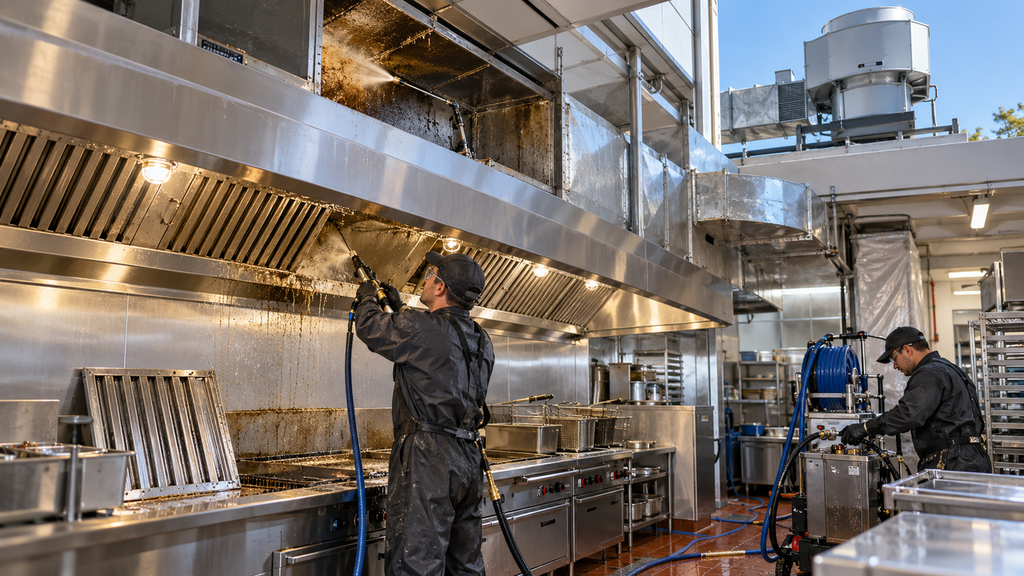
A professional kitchen exhaust cleaning service typically removes grease buildup from accessible portions of the commercial kitchen exhaust system, including the hood, filters, plenum, ductwork, and exhaust fan.
Depending on the system and provider, service may also include:
- Kitchen equipment protection
- Rooftop grease inspection
- Before-and-after photos
- Cleaning/service label
- Service documentation
- Notes about inaccessible areas
- Identified deficiencies
The objective is not simply to make visible stainless steel look clean. Professional service addresses grease within the exhaust path where restaurant employees normally cannot safely or effectively reach.
What Is a Kitchen Exhaust Cleaning Service?
Commercial kitchens produce grease-laden vapors whenever fryers, grills, ranges, charbroilers, and other cooking equipment operate.
Grease can accumulate throughout:
- Hood interiors
- Grease filters
- Plenum chambers
- Horizontal and vertical ducts
- Duct access areas
- Rooftop exhaust fans
- Grease collection components
Restaurant employees can maintain visible surfaces and removable filters, but complete commercial kitchen exhaust cleaning generally requires specialized equipment, access, procedures, and training. Markdown pegado
What Does Professional Kitchen Exhaust Cleaning Include?
Hood and Filter Cleaning
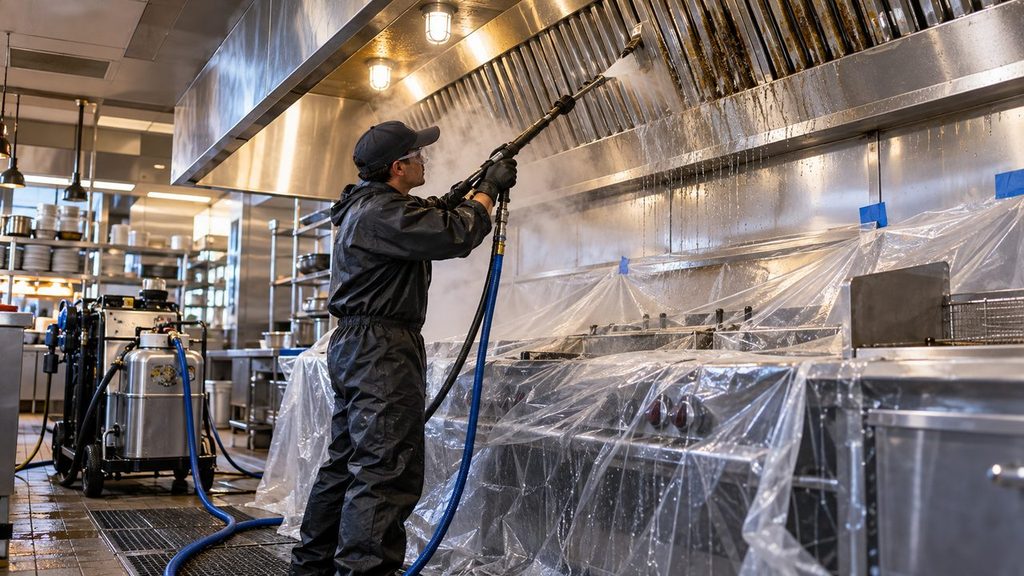
Technicians remove grease from accessible interior hood surfaces. Compatible filters may also be removed, cleaned, inspected, and reinstalled.
Plenum and Accessible Duct Cleaning
The plenum behind the filters can collect substantial grease. Grease can also accumulate inside ductwork where it cannot be seen from the cooking line.
Technicians clean accessible portions according to system design and available access.
Exhaust Fan Cleaning
Where safely accessible, service may address fan blades, housings, grease-contaminated components, and surrounding areas.
Work Area Protection and Cleanup
Nearby cooking equipment and surfaces should be protected before cleaning begins. Afterward, the immediate work area should be cleaned and components appropriately reinstalled.
Documentation
Professional service may include before-and-after photographs, service reports, cleaning labels, notes about inaccessible areas, identified deficiencies, and recommended corrective actions. Markdown pegado
Why Complete Exhaust-System Cleaning Matters
One common mistake is evaluating cleanliness only by looking at the visible hood.
A hood can appear clean while grease remains inside the:
- Plenum
- Ductwork
- Exhaust fan
- Access areas
- Rooftop components
Grease accumulation can contribute to fire hazards, persistent odors, airflow problems, smoke-capture issues, additional equipment strain, and inspection concerns.
Restaurant operators should therefore evaluate the condition of the complete accessible exhaust system, not only its appearance.
What Happens During Professional Kitchen Exhaust Cleaning?
A typical service follows an organized process.
1. System Review
The contractor may ask about cooking equipment, number of hoods, operating hours, roof access, known exhaust problems, and recent inspection concerns.
2. Work Area Preparation
Cooking equipment should have adequate time to cool. Technicians protect nearby surfaces and establish appropriate containment.
3. Hood and Filter Cleaning
Filters are removed when appropriate. Hood and plenum areas are degreased and cleaned based on system condition.
4. Duct and Fan Cleaning
Accessible duct sections and exhaust fan components are cleaned according to the agreed scope.
5. Cleanup and Documentation
Components are appropriately reinstalled, the work area is cleaned, and the provider should document completed work and visible deficiencies. Markdown pegado
How Should a Restaurant Prepare?
Before the appointment:
- Allow cooking equipment to cool
- Remove food and loose items
- Clear utensils from the hood area
- Confirm rooftop access
- Provide access to locked areas
- Inform employees about the service window
- Communicate airflow, odor, or grease concerns
- Share recent inspection issues
Many restaurants schedule cleaning overnight or during closed periods to minimize operational disruption.
How Often Should Kitchen Exhaust Cleaning Be Scheduled?
Frequency depends on cooking volume, fuel type, menu, grease production, operating hours, inspection findings, and local requirements.
A commonly referenced NFPA 96 inspection framework includes:
| Cooking Operation | Typical Inspection Frequency |
| Solid-fuel cooking | Monthly |
| High-volume cooking | Quarterly |
| Moderate-volume cooking | Semiannually |
| Low-volume cooking | Annually |
These are inspection frequencies, not automatic cleaning frequencies. Cleaning should be based on system condition and applicable requirements. Markdown pegado
NFPA 96 is a fire-safety standard, not a hood cleaning certification. Local requirements should also be confirmed with the applicable Authority Having Jurisdiction (AHJ).
Kitchen Exhaust Cleaning vs. Grease Trap Cleaning
These are different services.
Kitchen exhaust cleaning addresses grease above the cooking line within the hood, plenum, accessible ducts, and exhaust fan.
Grease trap cleaning addresses fats, oils, and grease within the restaurant’s plumbing and wastewater system.
General HVAC duct cleaning is also different from commercial grease-exhaust cleaning. Markdown pegado
What Documentation Should You Receive?
Restaurant owners should maintain organized records such as:
- Service date
- Areas cleaned
- Service report
- Before-and-after photos
- Cleaning label
- Inaccessible-area notes
- Deficiency reports
- Recommended repairs
- Recommended next service date
These records can be useful for maintenance management, property-management requests, insurance reviews, and inspections.
How to Choose a Kitchen Exhaust Cleaning Professional
Do not compare contractors based solely on price.
Ask whether they specialize in commercial kitchen exhaust cleaning, what components are included, whether technicians are properly trained, whether the business is insured, and whether they provide photographs and service documentation.
Also ask how inaccessible areas and deficiencies are reported.
About Chris Daskalakis
Chris Daskalakis is the founder of MFS Trade School and an entrepreneur focused on helping individuals build businesses in the commercial kitchen exhaust cleaning industry. Through MFS Trade School, Chris helps aspiring entrepreneurs and existing service-business owners develop the technical knowledge and business fundamentals needed to enter the kitchen exhaust hood cleaning industry.
Frequently Asked Questions
What is included in kitchen exhaust cleaning?
A typical service may include the hood, filters, plenum, accessible ductwork, exhaust fan, work-area protection, cleanup, and documentation.
Is cleaning the visible hood enough?
No. Grease may remain inside the plenum, ducts, access areas, and rooftop exhaust fan even when visible stainless steel looks clean.
Can restaurant employees clean the system?
Employees can maintain accessible surfaces and removable filters. Complete exhaust-system cleaning generally requires specialized equipment, access, procedures, and training.
How often should kitchen exhaust systems be cleaned?
Cleaning frequency depends on grease accumulation, cooking volume, equipment, inspection findings, and applicable requirements.
Should restaurants receive before-and-after photos?
They are highly recommended because they help document areas restaurant managers normally cannot see.
Final Thoughts
A professional kitchen exhaust cleaning service should do more than polish the visible hood.
Complete service addresses accessible grease throughout the exhaust path, provides documentation, identifies visible deficiencies, and helps restaurants maintain their commercial kitchen exhaust systems.
Need a Qualified Kitchen Exhaust Cleaning Professional?
The National Hood Cleaners Association (NHCA) provides resources for restaurant owners, facility managers, and commercial kitchen professionals looking for information about professional kitchen exhaust cleaning.
Visit NHCA to explore industry resources and learn more about working with qualified commercial kitchen exhaust cleaning professionals.
Want to Build a Kitchen Exhaust Hood Cleaning Business?
MFS Trade School provides professional training for entrepreneurs, pressure washing companies, commercial cleaners, and service-business owners who want to enter the kitchen exhaust cleaning industry.
Students learn cleaning procedures, exhaust-system fundamentals, equipment, safety, documentation, estimating, pricing, customer acquisition, and business development.
Explore MFS Trade School’s Kitchen Exhaust Hood Cleaning Certification and learn the technical and business skills needed to build a professional commercial hood cleaning operation.