
Quick Answer: What Should You Look for in a Hood Cleaning Service?
When hiring a hood cleaning service, look for a provider that cleans accessible portions of the complete kitchen exhaust system—not just the visible stainless-steel hood.
A professional provider should offer:
- Full-system cleaning scope
- Trained technicians
- Appropriate insurance
- Kitchen and equipment protection
- Clear before-and-after documentation
- Reliable scheduling
- Written service scope
- Identification of inaccessible areas or deficiencies
- Cleaning recommendations based on your operation
The best provider should be able to explain what will be cleaned, how it will be cleaned, what will be documented, and what is excluded before the job begins.
What Should Professional Hood Cleaning Include?
Grease does not stop at the visible hood.
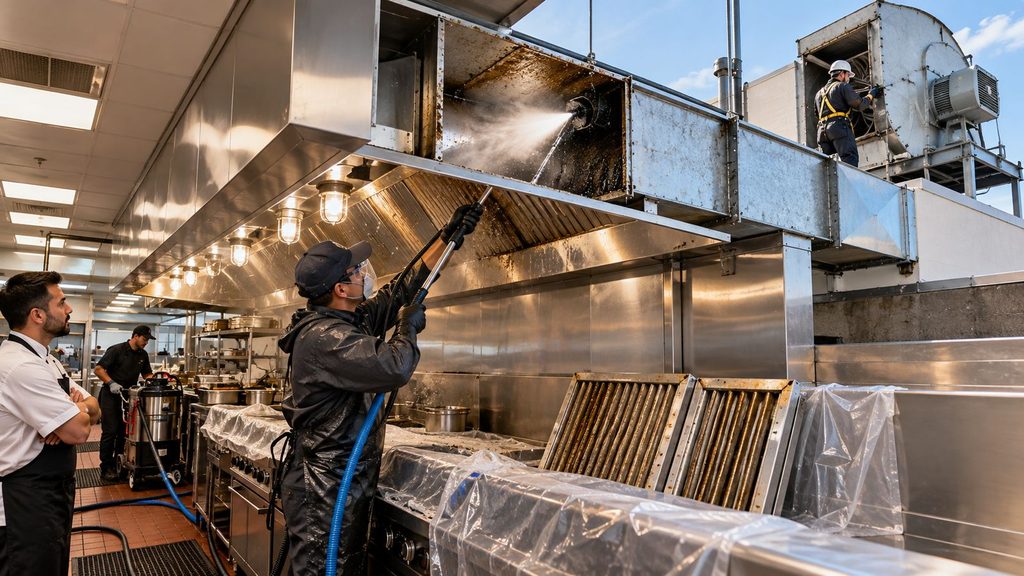
Grease-laden vapors can travel through the exhaust path and accumulate in filters, plenums, ductwork, exhaust fans, and grease collection areas.
Depending on system design and accessibility, professional kitchen exhaust cleaning may include:
- Pre-service system review
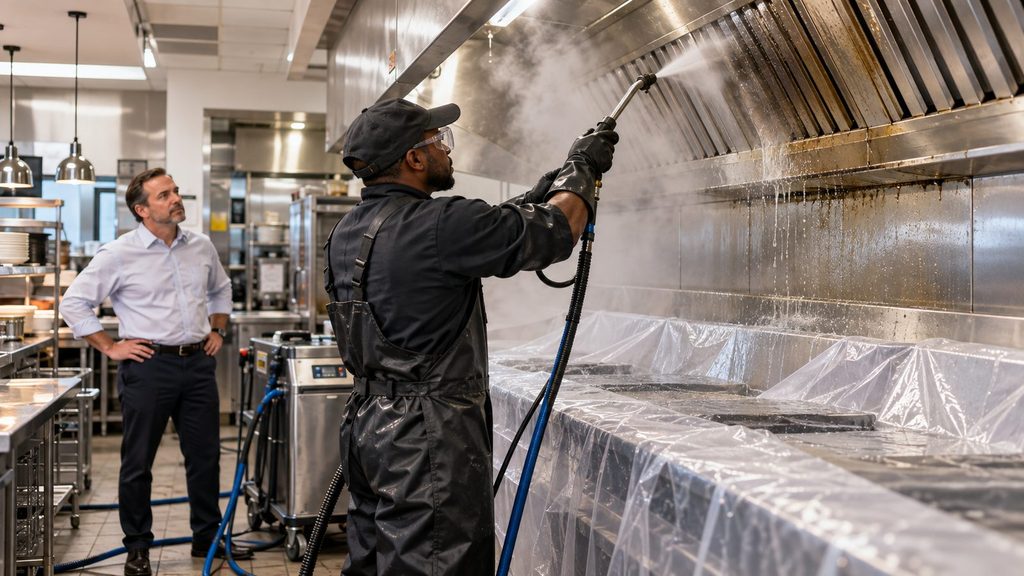
- Protection of cooking equipment
- Hood interior cleaning
- Grease filter cleaning
- Plenum cleaning
- Accessible duct cleaning
- Exhaust fan cleaning
- Grease containment cleanup
- Before-and-after photographs
- Final work-area cleanup
- Service documentation
Ask exactly what is included before accepting a quote.
A surface-only cleaning can leave hidden grease behind even when the visible stainless steel looks clean.
Training and Insurance Matter
Commercial hood cleaning involves water, chemicals, grease, electrical equipment, ladders, rooftops, and other workplace hazards.
Ask potential providers:
- Are your technicians trained?
- Do you carry general liability insurance?
- Do you maintain workers’ compensation coverage where applicable?
- Are you familiar with applicable fire-safety requirements?
- Do you follow appropriate chemical and equipment safety procedures?
- Do you hold any credentials required by the local jurisdiction?
Requirements can vary by location, so restaurant operators should also confirm applicable rules with their Authority Having Jurisdiction (AHJ).
NFPA 96 is an important commercial cooking fire-safety standard, but NFPA 96 itself is not a hood cleaning certification.
A hood cleaning contractor should also recognize the limits of its scope. Cleaning a kitchen exhaust system does not automatically replace separate inspection or servicing of fire-suppression equipment.
Documentation Should Show What Was Done
Restaurant operators should not be left guessing after the cleaning crew leaves.
Professional documentation may include:
- Service date and restaurant location
- Areas cleaned
- Before-and-after photos
- Inaccessible areas
- Visible deficiencies
- Recommended corrective action
- Suggested next service or inspection date
- Contractor information
Photos are especially useful because managers typically cannot see many parts of the exhaust system during normal operations.
Documentation also helps establish a maintenance history for managers, property teams, landlords, and other stakeholders.
How Often Should Your Exhaust System Be Serviced?
There is no single schedule appropriate for every commercial kitchen.
Frequency can depend on:
- Cooking volume
- Type of cooking
- Grease production
- Operating hours
- Fuel type
- System condition
- Inspection findings
- Local requirements
High-volume frying, grilling, charbroiling, wok cooking, or solid-fuel operations may require more frequent attention than lower-volume kitchens.
The important distinction is that inspection frequency and cleaning frequency are not necessarily the same.
A professional provider should evaluate system condition and explain its recommendations rather than automatically assigning every restaurant the same schedule.
Watch for These Hood Cleaning Red Flags
The cheapest quote is not always the best value.
Be cautious if a provider:
- Quotes without asking about your kitchen or exhaust system.
- Focuses only on visible hood surfaces.
- Cannot explain whether accessible ductwork and fan components are included.
- Avoids questions about insurance or training.
- Will not provide documentation or photos.
- Provides vague scheduling information.
- Does not explain kitchen containment and cleanup.
- Makes broad compliance guarantees without understanding your jurisdiction or system.
- Cannot explain how inaccessible areas will be documented.
Professional contractors should welcome questions about scope, access, documentation, and expectations.
Compare Providers With a Simple Checklist
Do not compare quotes based only on price.
Use a consistent framework:
| Factor | What to Verify |
|---|---|
| Cleaning Scope | Hood, filters, plenum, accessible ducts, fan |
| Training | Technician knowledge and procedures |
| Insurance | Appropriate business coverage |
| Protection | Containment and kitchen protection |
| Documentation | Photos, reports, deficiencies |
| Scheduling | After-hours availability and reliability |
| Communication | Clear scope and exclusions |
| Price | Cost relative to actual service provided |
Before signing, get the scope, exclusions, price, and expected service schedule in writing.
Why Kitchen Protection Matters
Professional hood cleaning can involve water, degreasers, loosened grease, hoses, and pressure washing equipment.
The contractor should have a clear containment process to protect:
- Cooking equipment
- Counters
- Floors
- Nearby appliances
- Food-contact areas
- Surrounding kitchen surfaces
Ask who prepares the work area, who handles final cleanup, and what condition the kitchen should be in when the crew leaves.
A professional service should minimize disruption and leave the work area ready for the restaurant’s next operating period.
About Chris Daskalakis
Chris Daskalakis is the founder of MFS Trade School and an entrepreneur focused on helping individuals build businesses in the commercial kitchen exhaust cleaning industry. Through MFS Trade School, Chris helps aspiring entrepreneurs and existing service-business owners develop the technical knowledge and business fundamentals needed to enter the kitchen exhaust hood cleaning industry.
Frequently Asked Questions
What should a hood cleaning service include?
Depending on accessibility and agreed scope, professional service may include the hood, filters, plenum, accessible ductwork, exhaust fan, grease collection areas, containment, cleanup, and documentation.
Should hood cleaners provide before-and-after photos?
They are highly recommended because they help document work performed in areas restaurant managers may not normally see.
Should I ask a hood cleaning company for insurance?
Yes. Ask prospective contractors about appropriate business insurance and any credentials required in your jurisdiction.
Is cleaning the visible hood enough?
No. Grease can accumulate inside the plenum, ductwork, exhaust fan, and other portions of the exhaust path.
Is NFPA 96 a hood cleaning certification?
No. NFPA 96 is a fire-safety standard addressing ventilation control and fire protection for commercial cooking operations; it is not itself a hood cleaning certification.
Final Thoughts
Choosing a professional hood cleaning service means looking beyond a shiny hood and a low quote.
Prioritize:
Full-System Scope + Training + Insurance + Documentation + Kitchen Protection + Reliable Scheduling
A professional contractor should explain exactly what will be cleaned, document the work performed, communicate deficiencies, and help you establish an appropriate maintenance routine.
Need Help Finding Hood Cleaning Industry Resources?
The National Hood Cleaners Association (NHCA) provides resources for restaurant owners, facility managers, and commercial kitchen professionals interested in professional kitchen exhaust cleaning.
Visit NHCA to learn more about commercial kitchen exhaust cleaning and resources for working with qualified professionals.
Want to Become a Professional Hood Cleaning Contractor?
MFS Trade School provides Kitchen Exhaust Hood Cleaning Certification for entrepreneurs, pressure washing companies, commercial cleaning businesses, and service contractors interested in entering or expanding within the kitchen exhaust cleaning industry.
Training covers exhaust-system fundamentals, cleaning procedures, equipment, containment, safety, documentation, estimating, pricing, customer acquisition, and business development.
Explore MFS Trade School’s Kitchen Exhaust Hood Cleaning Certification and learn the technical and business skills needed to build a professional commercial hood cleaning operation.