
Looking for a reliable restaurant hood cleaning service near me?
Choosing the right contractor is important for maintaining a commercial kitchen exhaust system, managing grease accumulation, and supporting restaurant fire safety.
Not every cleaning company provides complete kitchen exhaust cleaning. Some services focus on visible hood surfaces, while professional exhaust cleaning may involve filters, plenums, accessible ductwork, and exhaust fans.
This guide explains what restaurant owners should look for before hiring a commercial hood cleaning contractor.
Quick Answer: How Do You Find a Restaurant Hood Cleaning Service Near You?
To find a reliable restaurant hood cleaning service, look for a contractor specializing in commercial kitchen exhaust systems.
Verify the company’s qualifications, insurance, cleaning procedures, service documentation, and familiarity with applicable NFPA 96 requirements.
Before hiring, request a written scope of work explaining which exhaust-system components will be cleaned.
The following seven tips can help you compare providers.
1. Choose a Commercial Kitchen Exhaust Cleaning Specialist
Commercial kitchen exhaust cleaning is different from general restaurant cleaning.
Cooking equipment releases grease-laden vapors that can accumulate throughout the exhaust system.
Common components include:
- Hood interiors
- Grease filters
- Plenums
- Horizontal and vertical ductwork
- Exhaust fans
- Grease collection areas
A qualified contractor should understand how these components work together and how to clean accessible grease-contaminated areas.
2. Verify Training, Qualifications, and Insurance
Before hiring a restaurant hood cleaning company, ask about technician training and business insurance.
Useful questions include:
- Do you specialize in commercial exhaust cleaning?
- What training have your technicians completed?
- Do you carry appropriate commercial insurance?
- Are you familiar with NFPA 96?
- Do you meet applicable local requirements?
- Can you provide references?
Certification can demonstrate completed training, but it does not automatically replace local licensing or other requirements.
3. Request a Detailed Cleaning Scope
A professional contractor should clearly explain what the service includes.
Depending on system design and accessibility, the scope may cover:
- Hood interior cleaning
- Grease filter cleaning
- Plenum cleaning
- Accessible ductwork
- Exhaust fan components
- Grease collection areas
- Kitchen protection and containment
- Final cleanup
- Service documentation
A low-priced quote covering only visible hood surfaces should not be confused with complete exhaust-system cleaning.
Ask contractors to identify exclusions and access limitations before work begins.
4. Ask About NFPA 96 Requirements
NFPA 96 is the Standard for Ventilation Control and Fire Protection of Commercial Cooking Operations.
It addresses commercial cooking ventilation systems, including inspection, maintenance, and cleaning.
NFPA 96 is a fire-safety standard, not a cleaning certification.
A knowledgeable contractor should understand relevant requirements and how they relate to your kitchen.
Local authorities determine which editions and requirements apply.
How Often Should Restaurant Hoods Be Inspected?
A commonly referenced NFPA 96 inspection framework includes:
| Cooking Operation | Typical Inspection Interval |
|---|---|
| Solid-fuel cooking | Monthly |
| High-volume cooking | Quarterly |
| Moderate-volume cooking | Semiannually |
| Low-volume cooking | Annually |
These are inspection intervals, not universal cleaning schedules.
Actual cleaning depends on grease accumulation, inspection findings, system conditions, and applicable local requirements.
5. Confirm Service Documentation
Professional cleaning should include accurate documentation.
Ask whether the contractor provides:
- Service report
- Cleaning date
- Components serviced
- Cleaning label
- Before-and-after photographs
- Deficiency notes
- Documentation of inaccessible areas
Reports should accurately describe completed work.
If parts of the exhaust system cannot be accessed or cleaned, those limitations should be documented rather than ignored.
6. Compare Quotes Beyond Price
Restaurant hood cleaning costs vary based on system complexity and service requirements.
Pricing factors include:
- Number and size of hoods
- Grease accumulation
- Duct configuration
- Exhaust fan accessibility
- Roof access
- Service frequency
- Restaurant location
- After-hours scheduling
Compare quotes based on the components included, qualifications, documentation, and service procedures.
The cheapest estimate may not provide the most appropriate scope.
7. Watch for Warning Signs
Be cautious when a provider:
- Only offers visible hood cleaning
- Refuses to explain its scope
- Does not address ductwork or exhaust fans
- Cannot explain technician qualifications
- Does not provide documentation
- Ignores inaccessible areas
- Promises identical cleaning schedules for every restaurant
Professional service should be transparent.
Restaurant owners should know what was cleaned, what could not be accessed, and what needs further attention.
Signs Your Restaurant May Need Hood Cleaning
Common warning signs include:
- Visible grease accumulation
- Grease dripping from hood components
- Persistent greasy odors
- Heavy buildup around exhaust fans
- Missing or outdated service records
Smoke capture problems or reduced airflow may also indicate ventilation issues requiring professional inspection.
Do not assume cleaning alone will resolve mechanical or airflow problems.
What Happens During a Professional Hood Cleaning Visit?
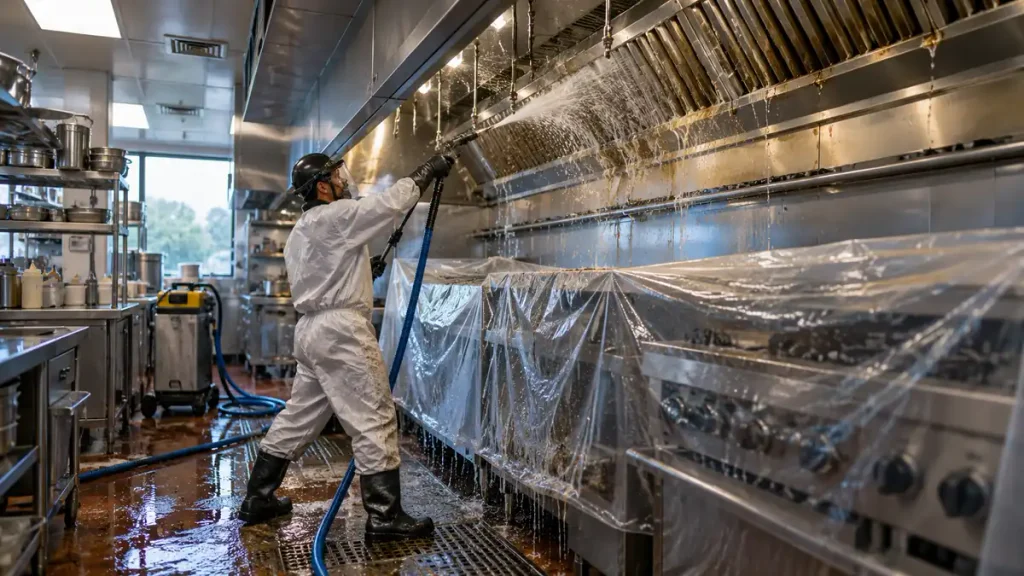
A typical service may involve:
- Reviewing the exhaust system and access points.
- Protecting cooking equipment and surrounding surfaces.
- Applying appropriate grease-removal procedures.
- Cleaning accessible exhaust-system components.
- Managing wastewater and cleaning materials.
- Reassembling components as appropriate.
- Documenting completed work and identified deficiencies.
Service procedures vary according to the system, contractor, and agreed scope.
How Much Does Restaurant Hood Cleaning Cost?
Restaurant hood cleaning prices depend on system size, configuration, grease accumulation, accessibility, and local market conditions.
Before accepting a quote, confirm whether it includes the hood, filters, plenum, accessible ducts, exhaust fan, cleanup, and documentation.
A detailed estimate helps restaurant owners understand what they are purchasing.
About Chris Daskalakis
Chris Daskalakis is the founder of MFS Trade School and an entrepreneur focused on helping individuals build businesses in the commercial kitchen exhaust cleaning industry. Through MFS Trade School, Chris helps aspiring entrepreneurs and existing service-business owners develop the technical knowledge and business fundamentals needed to enter the kitchen exhaust hood cleaning industry.
Frequently Asked Questions
How do I find restaurant hood cleaning services near me?
Search for local commercial kitchen exhaust cleaning specialists, verify their qualifications and insurance, and request written estimates detailing the cleaning scope.
What should a restaurant hood cleaning service include?
Depending on accessibility and system configuration, professional cleaning may include hoods, filters, plenums, ductwork, exhaust fans, cleanup, and documentation.
How often should restaurant hoods be cleaned?
Cleaning frequency depends on grease accumulation, cooking operations, inspection findings, and applicable local requirements.
Does NFPA 96 require hood cleaning?
NFPA 96 addresses commercial cooking exhaust-system inspection, maintenance, and cleaning. Specific obligations depend on the adopted edition and local jurisdiction.
Should I receive a report after hood cleaning?
Yes. Request documentation identifying the work completed, service date, and any inaccessible areas or deficiencies.
Final Thoughts
Finding a reliable restaurant hood cleaning service near you requires more than choosing the closest or cheapest provider.
Prioritize professional qualifications, complete service scope, appropriate insurance, accurate documentation, and knowledge of applicable fire-safety requirements.
A reliable contractor should explain what was cleaned, identify outstanding concerns, and help you understand appropriate maintenance planning.
Find Commercial Kitchen Exhaust Cleaning Resources Through NHCA
The National Hood Cleaners Association (NHCA) provides industry resources for restaurant owners, facility managers, and commercial kitchen professionals.
Visit NHCA to explore commercial kitchen exhaust cleaning resources and learn more about professional service practices.
Interested in Becoming a Hood Cleaning Professional?
MFS Trade School provides Kitchen Exhaust Hood Cleaning Certification for aspiring entrepreneurs, pressure washing companies, commercial cleaners, and existing service-business owners.
Training covers exhaust systems, professional cleaning procedures, equipment, safety, documentation, estimating, pricing, and business development.
Explore MFS Trade School’s Kitchen Exhaust Hood Cleaning Certification and learn how to develop the skills needed to enter the industry.