
Quick Answer: What Is a Restaurant Hood Cleaning Maintenance Schedule?
A restaurant hood cleaning maintenance schedule organizes routine and professional cleaning tasks for a commercial kitchen exhaust system.
A practical schedule includes:
- Daily: Clean visible hood surfaces and check grease collection areas.
- Weekly: Clean filters as appropriate and inspect for grease buildup.
- Monthly: Review maintenance records, airflow, grease accumulation, and service dates.
- Professional service: Inspect and clean the exhaust system according to cooking volume, grease accumulation, and applicable requirements.
Professional cleaning should address areas restaurant employees generally cannot safely reach, including the plenum, ductwork, and rooftop exhaust fan. Markdown pegado
Why a Restaurant Hood Cleaning Schedule Matters
Commercial kitchen exhaust systems capture grease-laden vapors, smoke, heat, and cooking contaminants.
Grease can accumulate throughout the hood canopy, filters, grease cups, plenum, ductwork, exhaust fan, and grease-containment components.
Without a structured restaurant hood cleaning schedule, staff may clean only visible surfaces while grease continues accumulating elsewhere in the exhaust system.
A documented maintenance schedule helps restaurants:
- Reduce grease-related fire hazards
- Maintain cleaner kitchen conditions
- Support ventilation performance
- Prepare for inspections
- Track professional cleaning
- Identify recurring maintenance problems
- Maintain organized service records
Cleaning the filters or visible stainless-steel hood does not mean the complete exhaust system is clean. Markdown pegado
Daily, Weekly and Monthly Hood Maintenance
Daily
Restaurant employees should focus on areas they can safely access:
- Wipe visible hood surfaces.
- Clean nearby cooking-line surfaces.
- Check grease cups and trays.
- Confirm filters are properly installed.
- Look for dripping grease or excessive buildup.
- Monitor smoke capture and airflow.
- Report unusual exhaust fan noise.
Grease odors, smoke escaping the hood, poor airflow, excessive heat, or dripping grease may indicate that professional inspection is needed. Markdown pegado
Weekly
Depending on cooking volume:
- Clean removable grease filters.
- Inspect filters for damage.
- Clean grease collection areas.
- Inspect visible hood components.
- Review cleaning logs.
- Check for recurring smoke, grease, or odor problems.
High-volume kitchens may require filter maintenance more frequently than once per week. Markdown pegado
Monthly
Management should review:
- Grease accumulation trends
- Filter condition
- Smoke capture and airflow
- Exhaust fan performance
- Employee cleaning logs
- Professional service dates
- Outstanding repair recommendations
If grease is accumulating faster than the existing schedule can manage, inspection or cleaning intervals may need to be shortened. Markdown pegado
How Often Should Professional Hood Cleaning Be Scheduled?
Professional commercial kitchen hood cleaning should consider cooking volume, fuel type, grease production, inspection findings, and local requirements.
NFPA 96 commonly uses inspection frequencies such as:
| Cooking Operation | Typical Inspection Frequency |
| Solid-fuel cooking | Monthly |
| High-volume cooking | Quarterly |
| Moderate-volume cooking | Semi-annually |
| Low-volume cooking | Annually |
Cleaning should be performed when inspection identifies grease accumulation requiring removal.
Operations using fryers, charbroilers, woks, solid-fuel equipment, or high-volume cooking lines may require more frequent professional attention.
Restaurants should always follow requirements established by their local Authority Having Jurisdiction (AHJ). Markdown pegado
What Should Professional Hood Cleaning Include?
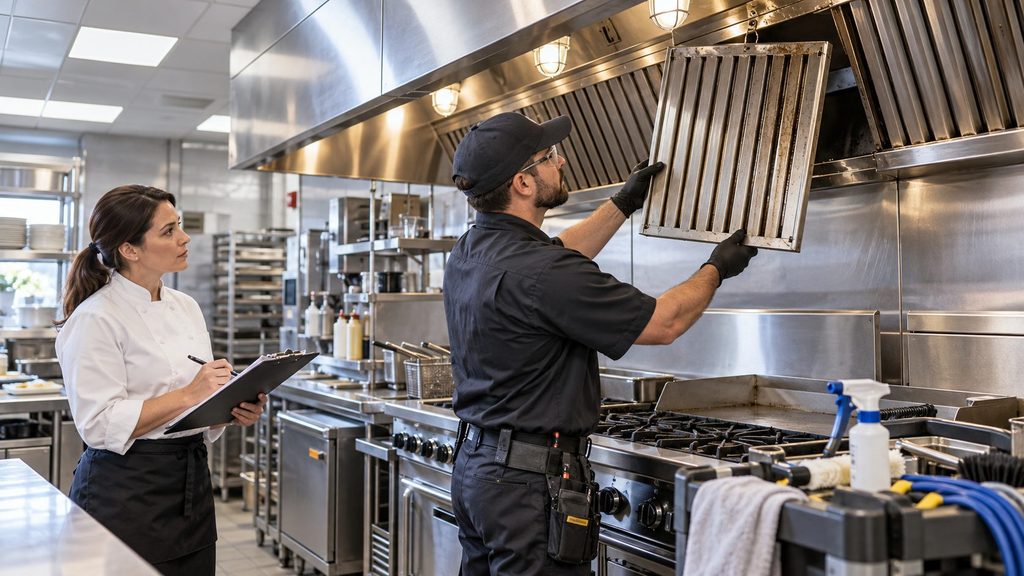
Professional kitchen exhaust cleaning goes beyond employee surface cleaning.
Depending on the system and contractor scope, service may include:
- Hood canopy and filter cleaning
- Plenum cleaning
- Accessible horizontal and vertical duct cleaning
- Rooftop exhaust fan cleaning
- Fan blade and housing cleaning
- Grease containment inspection
- Wastewater management
- Before-and-after photographs
- Service documentation
- Deficiency reporting
Restaurant owners should confirm the scope before hiring a contractor. Surface-only cleaning can improve appearance while leaving grease inside ductwork or the rooftop fan. Markdown pegado
Restaurant Hood Cleaning Checklist
Restaurant managers can simplify their maintenance program with this checklist:
Daily: Clean visible surfaces, check grease cups, monitor filters, airflow, smoke capture, and fan noise.
Weekly: Clean filters as appropriate, inspect visible buildup, check filter condition, and review staff logs.
Monthly: Review maintenance records, professional cleaning dates, deficiencies, repairs, and employee procedures.
After professional cleaning: Retain the service report and photographs, review deficiencies, confirm the cleaning label, and schedule the next service date. Markdown pegado
Keep Hood Cleaning Records
Documentation makes a maintenance schedule accountable.
Restaurants should retain:
- Employee cleaning logs
- Professional service reports
- Invoices
- Cleaning certificates or labels
- Before-and-after photographs
- Deficiency notices
- Repair recommendations
- Inspection records
- Next scheduled service date
These records may be useful during fire inspections, insurance reviews, property management audits, and facility maintenance planning. Markdown pegado
Common Restaurant Hood Maintenance Mistakes
Avoid four common problems:
Treating filter cleaning as complete exhaust cleaning. Clean filters do not mean the plenum, ducts, and exhaust fan are clean.
Waiting for visible grease. Hidden buildup may exist before grease begins dripping from the hood.
Using vague checklists. Assign specific tasks instead of simply writing “clean hood.”
Ignoring deficiency reports. Missing access panels, grease leakage, damaged filters, fan problems, and other reported issues should be evaluated. Markdown pegado
Find Qualified Hood Cleaning Professionals Through National Hood Cleaners Association
A strong maintenance program combines consistent restaurant staff cleaning with qualified professional service.
The National Hood Cleaners Association (NHCA) helps restaurant owners and facility managers learn about commercial kitchen exhaust maintenance and connect with professionals specializing in hood cleaning.
Find a qualified kitchen exhaust cleaning professional through National Hood Cleaners and establish a recurring maintenance schedule for your restaurant.
Interested in Learning Professional Kitchen Exhaust Cleaning?
Commercial kitchen exhaust systems require ongoing professional maintenance, creating a recurring service opportunity for contractors and entrepreneurs.
MFS Trade School provides professional education for individuals interested in entering or expanding within the kitchen exhaust hood cleaning industry, including:
- Kitchen Exhaust Hood Cleaning Certification
- Kitchen Exhaust Hood Inspection Certification
- Online Training
- Three-Day Hands-On Training
Training covers professional cleaning procedures, exhaust systems, equipment operation, documentation, estimating, pricing, inspections, and how NFPA 96 applies within the commercial kitchen compliance environment.
Explore MFS Trade School’s Kitchen Exhaust Hood Cleaning Certification and learn the technical and business skills needed to provide recurring commercial kitchen maintenance services. Markdown pegado
Frequently Asked Questions
How often should restaurant employees clean hood filters?
Frequency depends on cooking volume and grease production. High-volume or grease-heavy restaurants may require more frequent filter cleaning.
Does daily hood cleaning replace professional cleaning?
No. Employees can maintain accessible surfaces and components, while professional cleaning addresses areas such as plenums, ductwork, and rooftop exhaust fans.
How often should professional hood cleaning be performed?
Inspection frequency depends on cooking type and volume. The schedule in the source ranges from monthly for solid-fuel cooking to annually for certain low-volume operations. Markdown pegado
What records should restaurants keep?
Keep cleaning logs, professional service reports, invoices, labels, photographs, deficiency reports, and repair documentation.
When should the maintenance schedule change?
Dripping grease, saturated filters, persistent odors, poor smoke capture, rooftop grease, or repeated heavy buildup can indicate that the existing schedule is too infrequent. Markdown pegado